Key Takeaways
- The lubricant inside a manual gearbox, differential, or transfer case reduces wear on gears, bearings, and synchronisers under high load.
- It is a different product from engine oil. Using the wrong fluid in a transmission causes damage.
- API GL ratings (GL-4 and GL-5) define what a transmission lubricant is designed to protect, and the wrong rating for your gearbox can degrade synchroniser performance.
- Auto transmission oil, CVT fluid, and manual gearbox lubricant each serve different transmission types and are not interchangeable.
- A quality gear oil treatment added at each fluid change extends protection between service intervals and helps address early signs of wear in the transmission.
Introduction
The gearbox in your car works hard every time you drive. It takes power from the engine and delivers it to the wheels through a set of precision-machined gears, bearings, and, in most cases, synchronisers that allow smooth gear changes. All of that metal-to-metal contact needs lubrication. Without it, wear accelerates fast.
Gear oil is the lubricant that handles this job. It’s thicker and formulated differently from engine oil because the conditions inside a gearbox are different from those inside an engine. High pressure between gear teeth, the need to protect brass or steel synchronisers, and temperature swings from cold start to full operating heat all require a fluid built specifically for the task. Engine oil, despite being a quality lubricant for what it does, lacks the extreme pressure additive package that transmission components require.
This guide covers what this drivetrain fluid does, how API ratings work, when to replace it, and how to choose the right product for your vehicle type.
What Is Gear Oil?
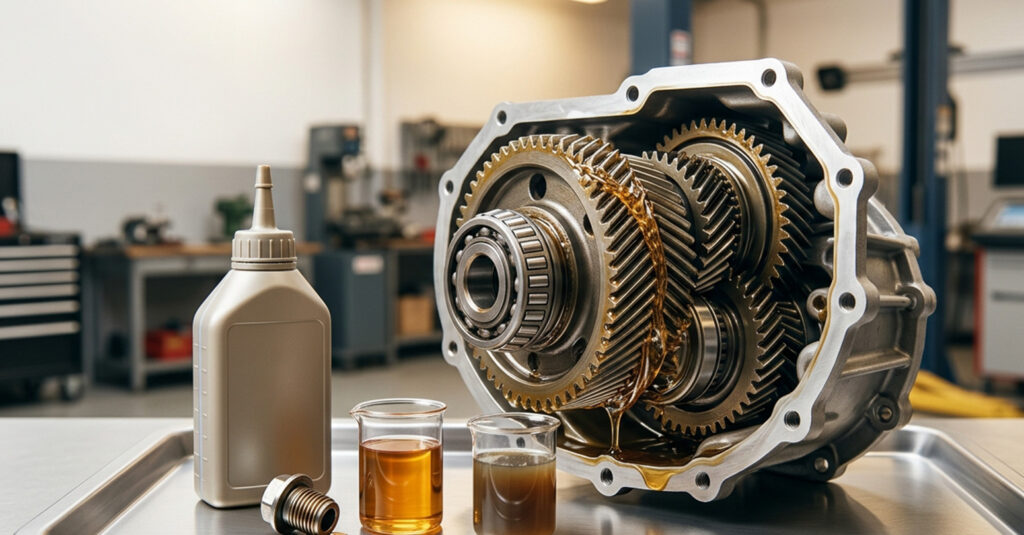
Gear oil is a high-viscosity lubricant formulated specifically for manual gearboxes, differentials, and transfer cases. It uses base oils and additive packages designed to handle extreme pressure between gear teeth, protect bearings under sustained load, and maintain smooth synchroniser engagement across a wide temperature range. Unlike engine oil, which circulates through a pressurised system, this lubricant typically sits in a sealed housing and relies on the movement of the gears themselves to distribute it across internal surfaces. The sealed design means contamination and degradation happen slowly and without obvious external signs, which is one reason scheduled fluid changes are the only reliable way to maintain protection.
What Does It Do Inside Your Gearbox?
The primary job of any gearbox fluid is to keep metal components from making direct contact with each other under load. Inside a manual transmission, gear teeth mesh under significant force every time you accelerate. Without a lubricating film between them, surface metal transfers from one tooth to another. Over time, it leads to rough gear engagement, noise, and eventually component failure.
Beyond basic lubrication, a well-formulated drivetrain fluid does several other things at once. It cools the gearbox by absorbing and dissipating heat from friction. It holds contaminants in suspension until the next fluid change. It protects against corrosion on metal surfaces in prolonged contact with the fluid. In transmissions with synchronisers, it allows the synchroniser cones to engage smoothly without slipping or dragging.
The additive package is what handles the extreme pressure requirement. The American Petroleum Institute classifies gear lubricants by GL rating, where GL-4 contains antiscuffing additives for moderate to heavy conditions and GL-5 contains a higher concentration of extreme pressure additives for hypoid gears and severe load conditions. GL-5 is not suitable for all manual gearboxes. The high sulphur-phosphorus additive concentration in GL-5 can attack the brass synchronisers found in many European and Asian transmissions. Matching the correct GL rating to your gearbox type is not optional. It affects both performance and longevity.
The viscosity grade matters too. A 75W-90 grade stays fluid enough at cold start to flow quickly to bearings before the gearbox warms up, while maintaining adequate film thickness at operating temperature under load. Thinner grades suit lighter-duty applications or specific OEM requirements. Thicker grades suit heavy axle loads and differentials.
Estremo’s ProTec Heavy Duty Synthetic Gear Oil 75W/90 GL-5 is formulated for both synchronised and unsynchronised manual gearboxes as well as axle drives. It handles high-speed, high-load conditions with a viscosity index of 146 and a pour point of -30°C, giving it a wide working temperature range for varied driving conditions.
Manual Gearbox Fluid vs Auto Transmission Oil: What’s the Difference?
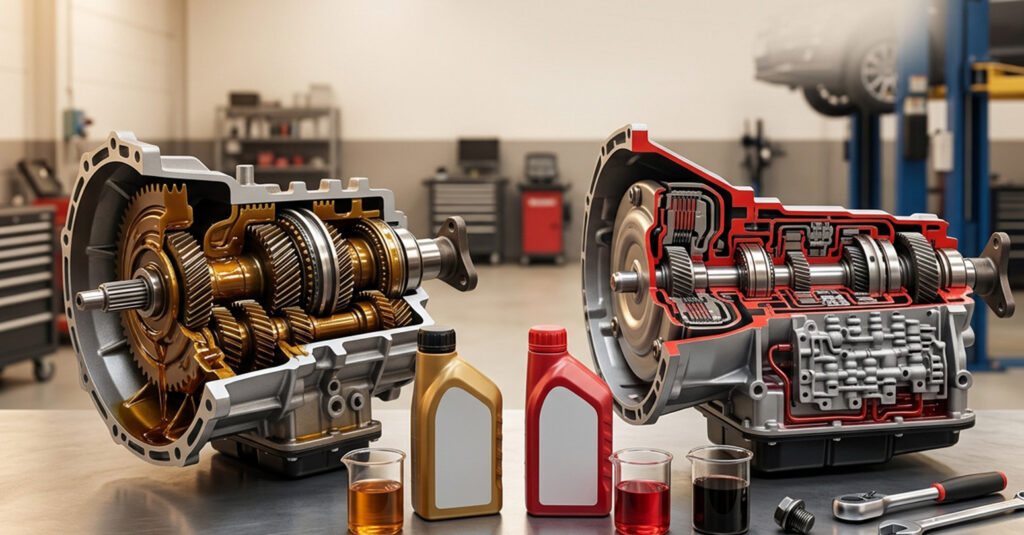
Drivers often use “gearbox fluid” and “transmission fluid” interchangeably. They’re not the same product and they’re not interchangeable.
The thick GL-rated fluid used in manual gearboxes, differentials, and transfer cases is formulated for gear-tooth meshing loads and extreme pressure conditions. It smells distinctly sulphurous because of the EP additive package. Auto transmission oil (ATF) is a completely different product. It’s lighter, friction-modified, and designed for the clutch packs, valve bodies, torque converters, and hydraulic circuits inside automatic transmissions.
ATF needs precisely controlled friction characteristics so the transmission shifts smoothly and consistently. Using the wrong fluid in an automatic transmission can cause shudder, harsh shifts, or internal damage to clutch packs and seals.
Substituting one transmission fluid type for another doesn’t just reduce performance. It changes the friction and load characteristics the gearbox was designed for, and the damage accumulates before any obvious symptom appears.
Estremo’s Fully Synthetic ATF LV covers modern low-viscosity automatic transmissions with OEM approvals including Toyota Type WS, GM Dexron VI, Ford Mercon LV, and Mercedes-Benz 236.12/14/41. The Fully Synthetic ATF MV handles older multi-vehicle automatic applications, including Toyota T-III and T-IV, Nissan Matic D and J, and Mitsubishi SPII and SPIII.
CVT-equipped vehicles require neither manual gearbox lubricant nor standard ATF. CVTs use a dedicated Fully Synthetic Multi CVT Fluid formulated for the steel belt and pulley system inside a continuously variable transmission. These systems are sensitive to fluid type. Using the wrong product causes rapid wear on the belt and pulley surfaces.
Where Gear Oil Treatment Fits In
A gear oil treatment is a supplemental additive used alongside the primary fluid at a service interval. It doesn’t replace the correct fluid. It adds a protective layer on top of what the base fluid already does, targeting specific gaps that come with age and accumulated mileage.
The principle is the same as using a protective additive with engine oil. The base fluid handles the primary lubrication job. The supplemental treatment addresses wear on surfaces that have already seen significant use, rejuvenates seals that have dried or hardened slightly over time, and helps clean deposits that have formed since the last fluid change.
Estremo’s Nano ATF Care is designed to rejuvenate seals, clean and lubricate sticking valves in automatic transmissions, and help address shift hesitation in worn transmissions. Add one bottle of 250ml to the existing transmission oil tank or when installing fresh ATF. It’s compatible with both existing and freshly changed fluid.
The Nano CVT & AT Treatment covers CVT and automatic transmission systems. Add 250ml for every 6 to 8 litres of transmission oil, ideally at every oil change for consistent protection.
This supplemental approach is worth considering in three situations: automatic transmissions showing early signs of shift hesitation or roughness, higher-mileage vehicles where seal integrity has started to decline, and any transmission coming off an extended fluid change interval where varnish or deposits may have built up.
Treating transmission fluid degradation before it causes noticeable shift quality issues is less expensive than waiting until the symptom is obvious. By the time a transmission slips or shudders consistently, internal wear has usually already progressed.
When Should Transmission Fluid Be Replaced?
The replacement interval depends on the transmission type, driving conditions, and the manufacturer’s specifications. Manual gearboxes in passenger cars typically call for a fluid change somewhere between 50,000 km and 100,000 km. Vehicles used for towing, mountain driving, or sustained high-load conditions benefit from shorter intervals.
Some manufacturer schedules describe gearbox fluid as a “lifetime fill.” In practice, a transmission lubricant that has been running for over 100,000 km in normal use has almost certainly degraded beyond its rated protection level. The “lifetime” label reflects expected vehicle life under ideal conditions, not real-world daily use.
Auto transmission oil degrades differently from manual gearbox fluid. ATF sees more heat cycles because automatic transmissions generate more heat through the torque converter and clutch pack friction. A typical ATF change interval runs between 50,000 km and 60,000 km under normal conditions. In stop-start urban traffic or towing use, 40,000 km is a more conservative and protective interval.
Signs that a fluid change is overdue include dark or opaque fluid instead of clear or amber, a burnt smell, noisy operation at speed, difficulty engaging specific gears, or rough automatic shifts. Catching these signs early is where a timely fluid change pays off more than waiting for consistent symptoms.
Is the Same Fluid Right for All Vehicles?
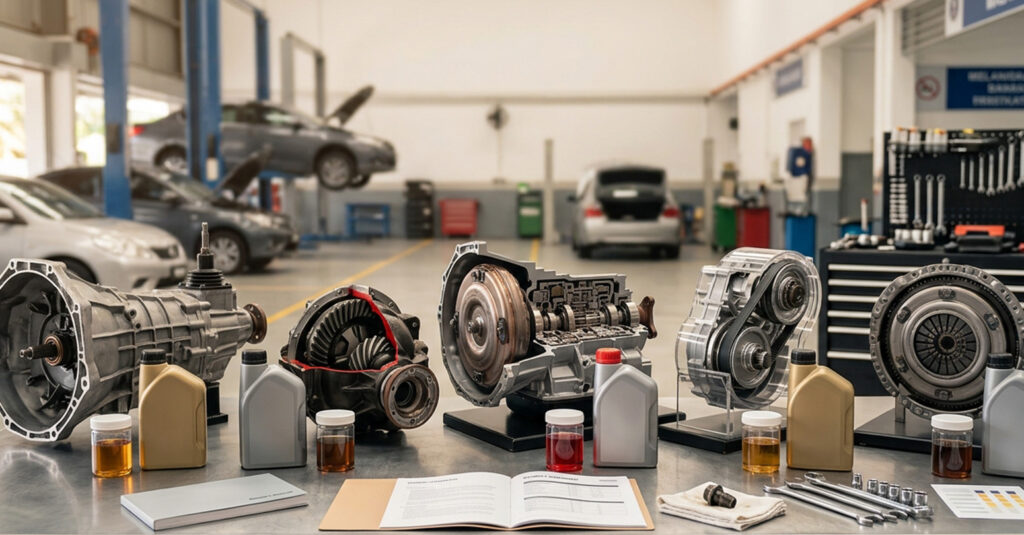
No. The correct fluid type, GL rating, and viscosity depend on your vehicle’s transmission type and the manufacturer’s approved specification.
Manual gearboxes typically use a GL-4 or GL-5-rated fluid at 75W-80 or 75W-90, depending on the application. Rear-wheel drive differentials with hypoid gears generally call for GL-5. Automatic transmissions require an ATF matched to the manufacturer’s OEM approval list. CVTs use a dedicated multi-vehicle CVT fluid. Dual-clutch transmissions often specify their own dedicated product separate from both manual gearbox fluid and ATF.
It’s also worth noting that not all GL-5 products carry the same OEM approvals. A vehicle manufacturer may specify their own in-house approval on top of the baseline GL-5 rating, particularly for European vehicles. The approval list on a product datasheet tells you more about real-world compatibility than the GL rating alone. Two products can both be GL-5 and still not be interchangeable for a specific vehicle.
The transmission section of your owner’s manual lists the required fluid type and approved specifications. That’s the authoritative source. Using a cross-category fluid because it’s convenient or cheaper is where drivetrain problems typically begin.
Explore Estremo’s full range of transmission fluids and drivetrain products to find the product matched to your drivetrain’s actual requirements.
Frequently Asked Questions
1. What is gear oil and is it different from engine oil?
Yes, they are different products with different formulations and different jobs. Gear oil is a high-viscosity lubricant formulated specifically for manual gearboxes, differentials, and axles. It uses extreme pressure additives to handle gear-tooth meshing loads that engine oil is not designed for. Using engine oil in a gearbox provides inadequate protection and accelerates internal wear.
2. How often should I replace gearbox fluid in a manual car?
A common interval for manual transmission fluid changes is every 50,000 to 80,000 km under normal driving conditions. Vehicles used for towing, mountain driving, or high-load use benefit from shorter intervals. Your owner’s manual specifies the manufacturer’s interval for your specific model and gearbox type. If the fluid looks dark or contaminated at a service check before the interval is reached, that’s a reliable signal to change it early, regardless of the scheduled kilometre mark.
3. What is the difference between GL-4 and GL-5?
GL-4 and GL-5 are American Petroleum Institute classifications for gear lubricants. GL-5 contains a higher concentration of extreme pressure additives for hypoid gears in differentials under severe load. GL-4 is the standard for manual gearboxes, particularly those with brass synchronisers. Using GL-5 in a GL-4 application can degrade synchroniser performance over time due to the more aggressive additive chemistry.
4. Can a transmission additive be used in an automatic gearbox?
A product designed for manual gearboxes is not the same as an ATF treatment. For automatic transmissions, use a product specifically formulated for ATF systems, such as Nano ATF Care or Nano CVT & AT Treatment. These are engineered for the friction characteristics and seal materials inside automatic and CVT transmissions. Adding the wrong treatment type can interfere with shift quality.
5. What does ATF do and when does it need changing?
ATF is the hydraulic and lubricating fluid inside an automatic transmission. It handles lubrication, hydraulic pressure for gear selection, and friction control across the clutch packs. A typical change interval is every 50,000 to 60,000 km under normal conditions. Signs that a change is overdue include dark or burnt-smelling fluid, rough gear shifts, and transmission hesitation under load.
Conclusion
Gear oil, ATF, and CVT fluid each protect a different drivetrain system in different ways. Using the wrong product in any of them changes the friction and load characteristics the system was engineered around. Degraded or contaminated transmission fluid rarely announces itself dramatically. The damage builds gradually through rougher shifts, more heat, faster wear on internal surfaces, and eventually a repair bill that a timely fluid change at the right interval would have prevented. Matching the right fluid type to your transmission and changing it on a sensible schedule is the lowest-cost, highest-return drivetrain maintenance decision you can make. A supplemental treatment product used at each service interval adds a further layer of protection between changes, extending the working life of the transmission components themselves. Explore Estremo’s full range of transmission and drivetrain products to find the right fit for your vehicle.