Key Takeaways
- Brake oil is hygroscopic. It absorbs moisture from the surrounding air over time, even inside a sealed system.
- As moisture accumulates, the boiling point drops. A lower boiling point means the fluid can vaporise under hard braking, causing vapour lock.
- DOT 4 brake fluid starts with a minimum dry boiling point of 230°C. As moisture builds, this drops toward the wet boiling point limit of 155°C.
- Regular checks catch fluid degradation before it affects braking response. A boiling point test gives the clearest picture of the condition.
- Estremo recommends flushing car brake fluid every six months. This prevents breakdown and vapour lock.
Introduction
Braking is the one system in a car that allows no room for gradual performance decline. Engine efficiency dropping slightly costs fuel. A rough-shifting transmission is an inconvenience. A brake system that responds less decisively than it should is a different problem entirely.
Brake oil is the hydraulic fluid that transmits pedal pressure to the calipers and drums. It lives inside a sealed system and does its job without any visible indication of its condition. Most drivers don’t think about it until the pedal feels spongy or a warning light appears. By then, the fluid has usually been deteriorating for some time. Unlike engine oil, which turns visibly dark over time, brake system fluid degrades chemically. The driver notices nothing until a braking event surfaces the problem.
This guide covers why the fluid degrades inside a sealed system and what that means for braking performance. It also covers how to check it and when a flush becomes necessary.
What Is Brake Oil?
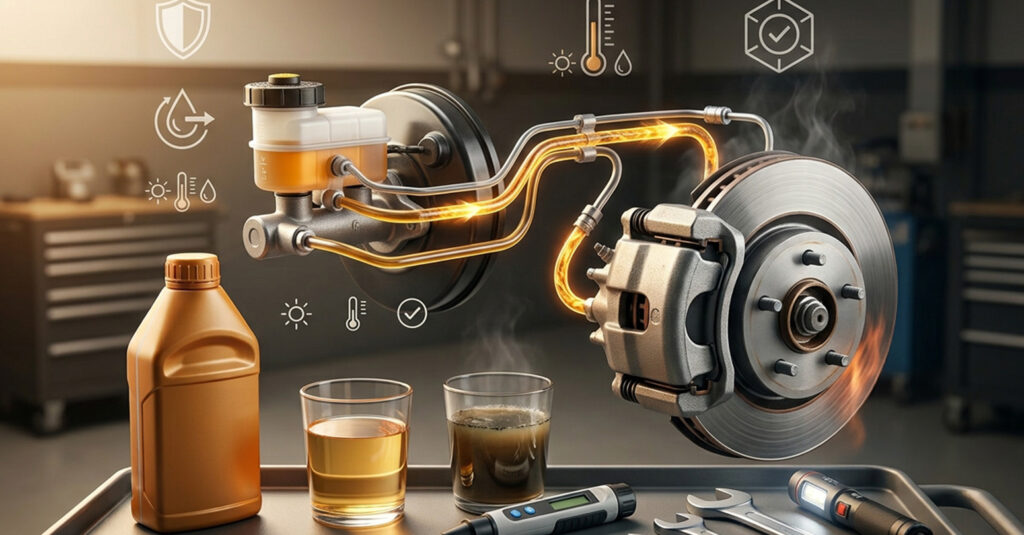
The fluid commonly called car brake fluid is glycol-based and hydraulic. It transmits pedal pressure through brake lines to the wheel cylinders or calipers. It must stay liquid and non-compressible at high temperatures. It also resists corrosion on internal metal components and maintains stable viscosity from cold starts through sustained hard braking. DOT ratings classify hydraulic fluids by dry and wet boiling points. Higher DOT numbers indicate higher heat resistance. The rating determines which systems the fluid is compatible with and what temperature range it can operate within safely.
Why Brake Oil Degrades Even When the System Looks Sealed
The brake reservoir and lines appear sealed from the outside. The fluid inside is not protected from moisture. Glycol-based hydraulic fluids are hygroscopic, meaning they absorb moisture from the surrounding air over time. Reservoir caps, line seals, and rubber hose materials all allow small amounts of moisture to enter gradually. This is a known chemical property of the fluid type, not a defect in the system.
The National Highway Traffic Safety Administration states that moisture absorption in a brake system degrades braking performance and safety. It does so by lowering the fluid’s boiling point and increasing the possibility of vapour lock and internal component corrosion.
Fresh DOT 4 fluid starts with a minimum dry boiling point of 230°C. As moisture enters the system, this drops toward the minimum wet boiling point of 155°C. The fluid doesn’t change in consistency enough for a driver to notice. The change is chemical, not visual.
The hydraulic fluid doesn’t announce its own deterioration. The system works normally until the fluid reaches a temperature at which it vaporises. At that point, the brake system loses its ability to transmit pressure. Braking response changes suddenly rather than gradually.
Moisture also promotes corrosion inside the brake system. Water in the lines accelerates rust on caliper pistons, wheel cylinder bores, master cylinder components, and ABS modulator passages. Corrosion debris circulates through the system over time. This creates a secondary maintenance problem on top of the boiling point issue.
The rate of moisture absorption also varies by conditions. A vehicle driven in high humidity absorbs moisture faster than one kept in a dry climate. An older system with aged rubber seals allows more ingress than a newer one. Short-trip use, where the engine rarely reaches full operating temperature, can accelerate degradation too. The fluid cycles through temperature extremes repeatedly without the sustained heat that might otherwise slow accumulation.
This is why the six-month flush recommendation exists regardless of mileage. A car parked in a humid garage absorbs moisture through the seals regardless of how far it’s driven. Time and environment both matter, not just distance.
What Happens When the Hydraulic Fluid Overheats
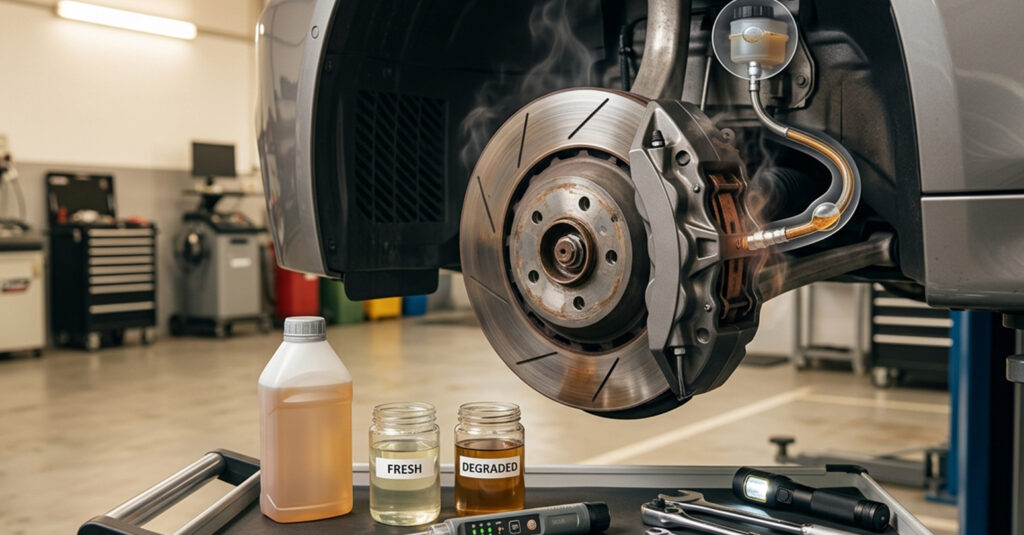
Vapour lock is the consequence of a fluid that has exceeded its effective boiling point. During hard braking, the system generates significant heat. Under sustained descents, repeated hard stops, or track driving, fluid temperature rises quickly. If the boiling point has already dropped, some of the fluid vaporises inside the lines or callipers.
Vapour is compressible. The hydraulic fluid in the brake line is not. A vapour bubble inside a brake line means pedal pressure compresses the bubble rather than applying force to the caliper. The pedal travels further before braking force builds. In extreme cases, the pedal goes to the floor with minimal braking effect.
A brake pedal that suddenly feels softer than usual during a prolonged descent is a warning sign. It signals that the fluid temperature has reached or exceeded its effective boiling point under current conditions.
This is why regular checks matter beyond routine maintenance. The system has a safety threshold. Degraded fluid narrows the gap between normal operating temperature and the point where vapour lock becomes possible.
The vehicle doesn’t need to be driven aggressively for this to become a concern. A long downhill stretch with frequent braking generates heat steadily. A driver who rarely services the brake system may encounter the symptom at a moment that requires full braking capability. Recognising the pedal feel change depends on how much remaining braking force the system can still deliver. A driver who rarely services the system may not notice the warning in time to respond safely.
How to Check Brake System Fluid Condition
Checking takes less than five minutes. Most vehicles have a translucent reservoir on top of the master cylinder, near the firewall on the driver’s side. It has MIN and MAX markings visible from outside.
A low level can indicate two things. Normal pad wear displaces fluid as caliper pistons extend over time. A sudden drop suggests a leak. Either way, the level should stay within the marked range.
Colour gives a rough guide to condition. Fresh fluid is pale yellow to amber. Older fluid turns darker as it absorbs contaminants and oxidises. Dark brown or black fluid has been in service too long. This visual check is not precise, but it identifies fluid that clearly needs attention.
A brake fluid test strip or refractometer gives a more accurate reading of moisture content or boiling point directly. Many service workshops offer this check as part of a routine inspection. If the test result falls below the minimum wet boiling point for its DOT rating, the fluid needs replacing. Visual condition alone is not enough.
One practical habit is to note the fluid colour at each oil change. Fresh engine oil and fresh hydraulic fluid tend to follow similar service cycles in cars with a regular schedule. If the engine oil looks dark by the next service, the brake fluid condition is worth checking too. Both systems degrade over time. Keeping track of both together is more practical than maintaining separate schedules.
The driver doesn’t need special tools for a level check. What the level and colour can’t tell you is the actual boiling point. That requires testing. Requesting a boiling point test at an annual service adds very little to the service cost. The result gives a precise reading of where the fluid sits within its safe operating range. That’s more useful than estimating from colour alone.
How Often Should You Flush the System?
Estremo recommends flushing car brake fluid every six months. This prevents breakdown and vapour lock. This interval reflects the reality that moisture absorption is continuous. It happens regardless of how much the car is driven.
Some manufacturer schedules suggest longer intervals of one to two years. These are conservative averages. Driving frequency, climate humidity, and the age of brake system seals all affect how quickly moisture accumulates. A car driven in high humidity absorbs moisture faster. Older brake systems with aged seals allow more ingress than newer ones.
Six months keep the fluid within a safe operating range without waiting for signs of degradation. Flushing replaces old fluid with fresh fluid. This restores the boiling point to its rated specification and removes moisture and contaminants from the system.
A flush also allows a mechanic to inspect the brake system while it’s open. Caliper condition, line integrity, and master cylinder function can all be checked at the same time. A combined inspection makes more of the service visit than a fluid swap alone. For a vehicle that skips scheduled services, this may be the first time several components have been inspected in years.
Is Brake Oil the Same Across All Cars?
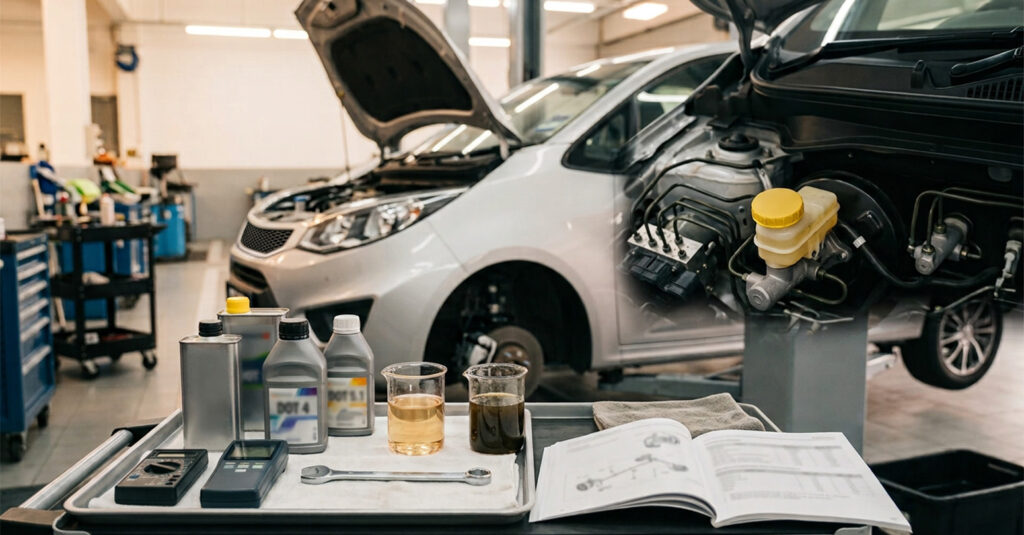
The correct fluid type depends on your vehicle. Most modern passenger cars require DOT 4 fluid. The cap on the brake reservoir and the owner’s manual both confirm the required rating. Using a lower-rated fluid in a system designed for a higher DOT rating reduces heat resistance under hard braking. Mixing incompatible types can also affect seal materials over time.
The DOT rating defines the minimum boiling point requirement. DOT 3 requires a minimum dry boiling point of 205°C. DOT 4 requires 230°C. DOT 5 is silicone-based and not compatible with glycol-based systems. Using the right type for your system is not optional. The system was designed around a specific fluid chemistry and performs within those limits when the correct product is used.
Estremo’s Synthetic Brake Fluid DOT 4 suits modern high-performance disc and drum brake systems. It covers ABS systems and hydraulic clutch systems in passenger cars where a DOT 4 type fluid is required. The formulation is designed for both performance and longevity within the six-month flush cycle Estremo recommends.
The Estremo guide on brake fluid DOT ratings covers boiling points and where each type applies.
Frequently Asked Questions
1. Why does the hydraulic fluid in my brakes need to be changed regularly?
The hydraulic fluid in the brake system transmits braking force from the pedal to the calipers or drums. It’s glycol-based and absorbs moisture over time. As moisture accumulates, the boiling point drops. A lower boiling point means the fluid can vaporise under hard braking, causing vapour lock and loss of pedal firmness. Regular changes keep the fluid within its rated temperature limits and prevent both vapour lock and internal corrosion.
2. How often should I check the hydraulic fluid in my brakes?
A visual level check every few months is practical for most drivers. A boiling point test at each service or at least annually gives a more accurate picture of condition. Estremo recommends flushing every six months to prevent breakdown and vapour lock. This accounts for continuous moisture absorption regardless of driving frequency.
3. What does the DOT 4 rating mean on hydraulic fluid?
DOT 4 is a classification set by the US Department of Transportation. It defines minimum boiling point requirements for hydraulic brake systems. DOT 4 requires a minimum dry boiling point of 230°C and a minimum wet boiling point of 155°C. These thresholds define the temperature range within which the hydraulic fluid must remain non-compressible. At or above the wet boiling point, the risk of vapour lock under sustained hard braking becomes real.
4. Can I top up the brake reservoir fluid myself?
Topping up is straightforward if the level dropped gradually from normal pad wear. Use only the fluid type specified on the reservoir cap or in the owner’s manual. If the level dropped suddenly, have the system checked for a leak before adding fluid. Topping up does not replace a full periodic flush. Adding fresh fluid to degraded fluid also does not restore the boiling point to specification. A full flush is the only way to do that.
5. What does a spongy brake pedal mean?
A spongy or soft pedal usually means air or vapour is present in the brake lines. Air enters during an incomplete flush. Vapour forms when fluid overheats and partially vaporises. Both make the system compressible and reduce braking force. A pedal that becomes spongy during or after heavy braking is a stronger indicator of vapour lock from degraded fluid. Have the system inspected promptly.
Conclusion
The brake system’s hydraulic fluid is one of the few maintenance items where neglect carries direct safety consequences. Most fluids degrade gradually and mechanically. This one has a threshold. The fluid absorbs moisture continuously, the boiling point falls, and the safety margin narrows. None of this is apparent from the driver’s seat until the pedal behaves differently under pressure. When that moment arrives, the fluid’s condition determines how much braking force reaches the wheels. Regular checks and a six-month flush interval keep the system within its designed limits. Explore Estremo’s Synthetic Brake Fluid DOT 4 to keep your brake system operating within specification.