Key Takeaways
- A fuel injector delivers fuel in a precisely controlled spray pattern. When deposits build on the tip or inside the nozzle, that precision is lost.
- Disrupted spray patterns force the engine to compensate, which affects combustion efficiency and can reduce fuel economy over time.
- Research published by the Society of Automotive Engineers has shown that fuels with deposit control additives maintain engine performance better than those without, particularly in direct injection engines.
- A fuel system cleaner works by dissolving varnish and deposit buildup from the intake valve through to the injector nozzle.
- Using a quality cleaner at regular service intervals is one of the more practical steps a driver can take to support fuel efficiency over the long term.
Introduction
Fuel economy rarely drops overnight. It tends to drift slowly over weeks and months. A tank that used to cover a certain distance starts coming up a little short. The engine still starts cleanly. Nothing obvious feels wrong. But the numbers at the pump don’t add up the way they used to.
One contributor to this kind of gradual change is the condition of the injection system. A dirty or partially blocked nozzle delivers fuel less precisely than a clean one. The combustion cycle becomes slightly less efficient. The engine management system compensates by adjusting fuel delivery, which can work against fuel consumption rather than for it. The result is a vehicle that feels similar to drive day to day but costs more per kilometre to run.
This guide addresses whether a fuel system cleaner can genuinely help fuel efficiency and how the mechanism works. It also covers what products support fuel system maintenance as part of a regular service routine.
What Is a Fuel Injector?
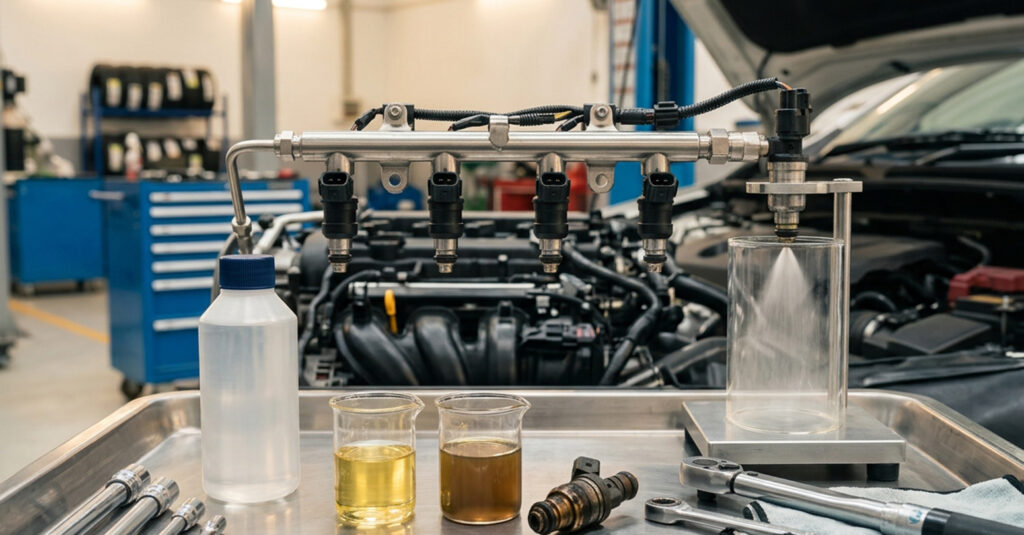
A fuel injector is an electronically controlled valve. It delivers a precisely measured spray of fuel into the combustion chamber or intake port. Modern engines time injection to fractions of a millisecond and control spray pressure and pattern to optimise combustion. The injector tip, which produces the fuel spray, is exposed to intense heat from the combustion chamber between injection events. Over time, fuel residue and combustion by-products build up on the tip. This alters the spray pattern and reduces the amount of fuel delivered per cycle.
How Deposits Form and Affect Combustion
Injector deposits form gradually through two main processes that compound over time and accelerate with higher mileage. The first is heat damage. At the end of each injection event, a small amount of fuel remains on or near the injector tip. Heat from the combustion chamber causes this residual fuel to break down and harden. It leaves a varnish or carbon layer on the metal surface. The second process is residue from the fuel itself. Additives and lubricants in fuel can break down and leave deposits on injector surfaces over time.
As deposits accumulate, the injector’s performance changes in measurable ways. The spray pattern becomes less uniform. Flow rate decreases as deposits narrow the nozzle opening. Some injectors begin to dribble fuel between injection events rather than delivering a clean, sharply cut-off spray. The result is that the combustion event receives a less precise fuel charge than the engine management system intended.
Research into diesel injector deposits found that injectors fouled without deposit control additives showed significant power loss. Only fuels containing deposit control additives maintained engine performance and prevented meaningful changes in fuel consumption under test conditions.
A partially blocked or deposit-coated injector doesn’t fail in any obvious way. It simply delivers fuel less precisely than it was designed to. That imprecision has a cumulative effect on how efficiently the engine burns each tank of fuel.
The same principle applies to petrol engines. Direct injection engines spray fuel straight into the combustion chamber. The injector tip faces intense heat with every cycle, which accelerates deposit formation. Port injection engines accumulate deposits more slowly. They are not immune, but the buildup rate is lower than in direct injection designs. Older engines with long service histories and no prior fuel system care are the most likely to show performance changes. Deposit buildup is the usual culprit.
Does Cleaning the Fuel Injector Actually Improve Fuel Efficiency?

The connection between injector cleanliness and fuel economy is a mechanical one. A clean nozzle produces the spray pattern its design specifications call for. Fuel breaks into fine droplets correctly. The combustion event receives the right mix of fuel and air at the right moment. Nothing wasted, nothing lost.
A fouled nozzle disrupts this sequence. The spray pattern becomes irregular. Some of the fuel doesn’t combust completely. The engine management system reads this as a sub-optimal combustion event and compensates. In some cases, the system adds slightly more fuel to achieve the power output the driver is requesting. This means a higher fuel consumption rate to produce the same driving result.
Cleaning the injector system removes the deposits that cause this disruption. The spray pattern returns to specification. Combustion becomes more efficient. Fuel consumption returns closer to what the engine was designed to deliver when the injector system is clean.
Fuel economy improvements from a clean fuel system are not dramatic on a clean engine. On an engine with significant deposit buildup, returning the injectors to clean specification can make a meaningful difference to consumption across a tank.
The degree of improvement depends on how much deposit has accumulated before treatment. On a newer engine with minimal buildup, a preventive fuel system cleaner maintains efficiency rather than restoring it. On a vehicle with 60,000 km or more and no prior fuel system service, the improvement is more noticeable. The engine was working harder than it should to deliver the same output. Removing the deposits reduces that compensatory load.
How Fuel System Cleaners Work
A fuel system cleaner is added directly to the fuel tank. It circulates through the entire fuel system during normal driving. It reaches the fuel pump, fuel rail, injector bodies, and injector tips, working progressively through each component. The cleaning agents dissolve varnish and carbon deposits. These are suspended in the fuel, pass through the combustion chamber, and exit as exhaust.
The cleaning action is not immediate. Over one full tank of fuel, the cleaner works progressively. Harder deposits may require more than one treatment across consecutive tanks. Regular use at service intervals is more effective than a single reactive treatment after symptoms appear. Think of it as ongoing maintenance for the fuel delivery system rather than a one-time fix.
Estremo’s Nano Fuel Cleaner cleans the entire petrol fuel system from the intake valve through to the injector tip. Its nano additive formulation removes varnish and deposits. It also forms a protective layer on metal surfaces to help prevent future buildup. Add 250ml to the fuel tank at each fill-up, and use at every 5,000km interval for ongoing protection.
For diesel vehicles, the Nano Diesel Cleaner covers the same function for common rail direct injection (CRDI) systems. The formulation uses nnanotechnologyto remove varnish and deposits from the intake valve to the injector nozzle. It also protects the nozzles against future fouling. Add 250ml per 50 litres of diesel and use at every 15,000km interval.
For petrol drivers who also want to support combustion quality, the Nano Octane 108 and Injector Cleaner are worth considering. It combines an octane booster with injector cleaning in one product. It lubricates and protects injectors, cylinder walls, and valves while stabilising fuel quality across different fill-up sources. Add 250ml to the petrol tank and fill to full.
For drivers looking for fuel injector cleaner Malaysia options, Estremo’s additive range is available through local distribution partners. Find the full listing at estremointernational.com.
What Other Factors Affect Fuel Efficiency?

Injector cleanliness is one contributor to fuel economy. Other factors operate alongside it. Tyre pressure, oil grade, air filter, spark plug condition, and driving behaviour all affect fuel efficiency. Each plays a role alongside injector cleanliness. A clean fuel system can’t compensate for degraded oil or worn spark plugs. The engine’s overall condition determines how much efficiency is recovered.
Drivers who want to improve fuel efficiency get better results when they treat it as a whole-engine question. Fuel system cleanliness, engine oil quality, air intake condition, and driving habits all contribute. Addressing only one and ignoring the others gives an incomplete result. A fuel system cleaner used alongside quality engine oil maintains overall engine efficiency better than either product used alone.
The Estremo P7 Semi-Synthetic and P9 Fully Synthetic engine oils pair with the fuel additive range. Together, they cover both engine lubrication and fuel system cleanliness. One looks after the moving parts inside the engine. The other keeps the fuel delivery system clean and accurate.
Keeping the catalytic converter clean is also relevant. The Estremo Nano Catalytic Converter Cleaner supports converter efficiency. A cleaner converter affects how efficiently the engine burns fuel and what downstream emissions look like. A partially blocked converter creates back pressure that the engine works against, which has its own effect on fuel consumption.
Does Fuel System Cleaner Work for All Vehicle Types?
Petrol system cleaners are not the same product as those designed for diesel engines. Petrol and diesel fuel systems have different chemical compositions, different injector designs, and different deposit types. Using a petrol cleaner in a diesel vehicle, or vice versa, may not produce the intended effect. It could also affect fuel system components. Always select a product specified for your vehicle’s fuel type.
Port injection engines accumulate deposits differently from direct injection engines. The heat exposure and deposit type differ between the two designs. Direct injection engines face higher deposit intensity at the injector tip due to greater heat exposure. Both benefit from regular fuel system maintenance. Direct injection engines tend to show more noticeable improvements because deposit conditions are more severe.
Looking to improve fuel efficiency through fuel system maintenance? The product type is only part of the answer. Frequency matters just as much. A single treatment after years of no maintenance shows some improvement. Consistent use at the specified interval delivers better long-term results. Start by matching the right cleaner to the right engine type. Follow that with regular use at the specified interval rather than infrequent reactive treatments.
Frequently Asked Questions
1. Can a fuel system cleaner improve my car’s fuel economy?
A fuel injector cleaner can support fuel economy by removing deposits that disrupt the spray pattern and reduce combustion efficiency. The degree of improvement depends on how much deposit buildup was present before treatment. On a well-maintained engine with minimal fouling, the cleaner maintains current efficiency. On a higher-mileage engine with no prior fuel system service, the effect is more noticeable.
2. How often should I use a fuel system cleaner?
For petrol vehicles, add 250ml of a fuel system cleaner every 5,000km. This prevents deposit accumulation rather than waiting for performance to slip. For diesel vehicles, 250ml per 50 litres of diesel every 15,000km covers the recommended interval. Consistent use at these intervals is more effective than infrequent reactive treatment. The goal is to prevent deposits from reaching the point where they affect the spray pattern. Once the injector surface is clean, keeping it that way takes much less effort than restoring a heavily fouled system.
3. Is there a difference between a petrol and diesel system cleaner?
Yes. Petrol and diesel fuel systems have different chemical requirements, different injector designs, and different types of deposits. Products formulated for petrol fuel systems are not interchangeable with diesel system cleaners. Always select a product matched to your vehicle’s fuel type. Estremo’s Nano Fuel Cleaner is for petrol vehicles; the Nano Diesel Cleaner is formulated specifically for CRDI diesel systems.
4. Will a fuel system cleaner fix a rough idle or hesitation?
A fuel system cleaner can help if the problem comes from deposit buildup on injectors or intake valves. If the cause is a failing sensor, worn spark plug, or air intake problem, a cleaner alone won’t resolve it. A fuel system clean is a useful first step. Persistent symptoms still warrant a proper diagnostic inspection.
5. Where can I find fuel injector cleaner in Malaysia that drivers use?
Estremo’s Nano Fuel Cleaner and Nano Diesel Cleaner are available through the Estremo product page and local distribution partners. Both use nanotechnology and suit regular service intervals rather than one-time use. Visit the Estremo additives range for the full product listing.
Conclusion
Fuel efficiency doesn’t have one switch to flip. It’s the sum of how well each system in the engine is doing its job. A clean injection system produces the spray pattern the engine was designed around. When deposits interrupt that pattern, combustion becomes less precise ,and consumption rises gradually. A quality fuel system cleaner used at regular intervals removes that variable from the equation. It won’t compensate for worn components or poor driving habits. As part of a consistent routine, it keeps fuel economy contributors working as intended. Explore Estremo’s full fuel system additive range to find the right product for your vehicle type and fuel system.