Key Takeaway
- Car coolant types differ not just in colour but in the protective additives they contain, which determine how long they last and which engines they suit.
- IAT is the older formula, works well for vehicles with cast iron and copper parts, but needs changing every two years.
- OAT is the standard for most modern passenger cars and can last up to five years.
- HOAT and P-HOAT blend both approaches, with most Asian cars from Toyota, Nissan, Honda, and Hyundai using P-HOAT.
- Using the wrong coolant or mixing two different types can speed up corrosion inside the cooling system, so always check your owner’s manual first.
Introduction
Coolant is easy to overlook until a temperature warning light appears on the dashboard. But what’s in that reservoir matters more than it looks. Grab two bottles of radiator coolant from a shop shelf, and they might look similar, cost about the same, and still be completely incompatible with each other.
Car coolant types differ at the chemical level. The protective additives inside each one determine how long it lasts, what metals it’s safe for, and whether it plays well with what’s already in your engine. Using the wrong type doesn’t just reduce protection. In some cases, it speeds up the very corrosion it’s supposed to prevent.
What Are the Main Car Coolant Types?
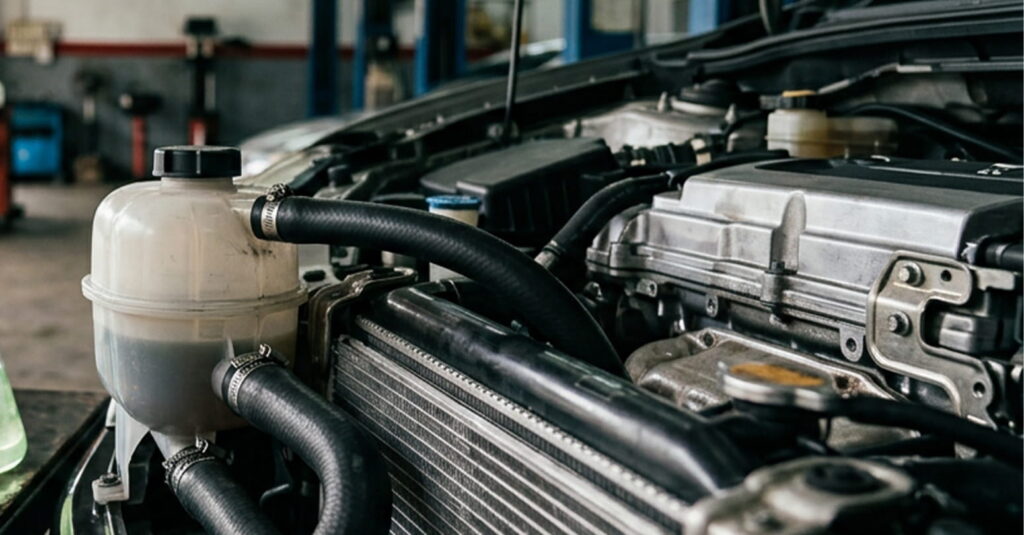
All coolants share the same base liquid, ethylene glycol, which is the chemical that stops water from boiling or freezing at extreme temperatures. What creates the different car coolant types is the mix of rust-prevention additives inside. Those additives behave differently depending on what metal your engine is made from.
All car coolant types share the same base liquid. What separates them is the rust-prevention chemistry inside, which determines how long they last and which engines they suit.
IAT: The Original Formula
IAT stands for Inorganic Additive Technology, the classic green or blue coolant you’d see in older cars. The additives inside, mainly silicates and phosphates, work quickly and cover older engine materials well: cast iron blocks, brass fittings, and copper radiators.
Those additives wear out rather than lasting indefinitely. IAT needs to be changed every two years or around 30,000 kilometres. Leave it too long, and it turns acidic, attacking the metal it was meant to protect. Older vehicles with traditional metal parts are where IAT belongs. Modern engines built mostly from aluminium aren’t well-suited to it.
OAT: The Modern Standard
Unlike IAT, it became the standard for most modern cars because its rust-prevention chemistry lasts considerably longer, up to five years or around 240,000 kilometres. OAT additives form a bond directly with metal rather than wearing down from the surface, so they need less frequent renewal.
It takes slightly longer to reach full effectiveness after a change and isn’t compatible with older copper and brass cooling systems. You may have seen it sold as Dex-Cool, a well-known OAT brand used in most GM vehicles. It’s also common across modern European and Japanese models.
HOAT and P-HOAT: The Hybrid Options
HOAT (Hybrid Organic Acid Technology) blends the two approaches. It keeps the quick-acting coverage of IAT while adding OAT’s longer-lasting protection. Ford, Chrysler, and several European manufacturers specify it.
P-HOAT is a phosphate-based variant used widely by Asian car makers including Toyota, Nissan, Honda, and Hyundai. Phosphate formulas provide fast initial coverage without the downsides silicates can cause in high-concentration cooling systems. If you drive a Japanese or Korean car, your manual likely specifies P-HOAT.
One rule that matters: HOAT and OAT are not interchangeable. Mixing the two interferes with both their protective properties and can leave your cooling system worse off than either product alone.
Which Car Coolant Type Does Your Vehicle Need?
| Coolant Type | What It’s For | How Long It Lasts | What’s Inside |
| IAT | Older vehicles with cast iron and copper parts | ~2 years / 30,000 km | Silicates and phosphates |
| OAT | Most modern passenger cars | ~5 years / 240,000 km | Organic rust-prevention acids |
| HOAT | Ford, Chrysler, some European makes | ~4-5 years | Organic acids + silicates |
| P-HOAT | Toyota, Nissan, Honda, Hyundai, most Asian makes | ~5 years | Organic acids + phosphates |
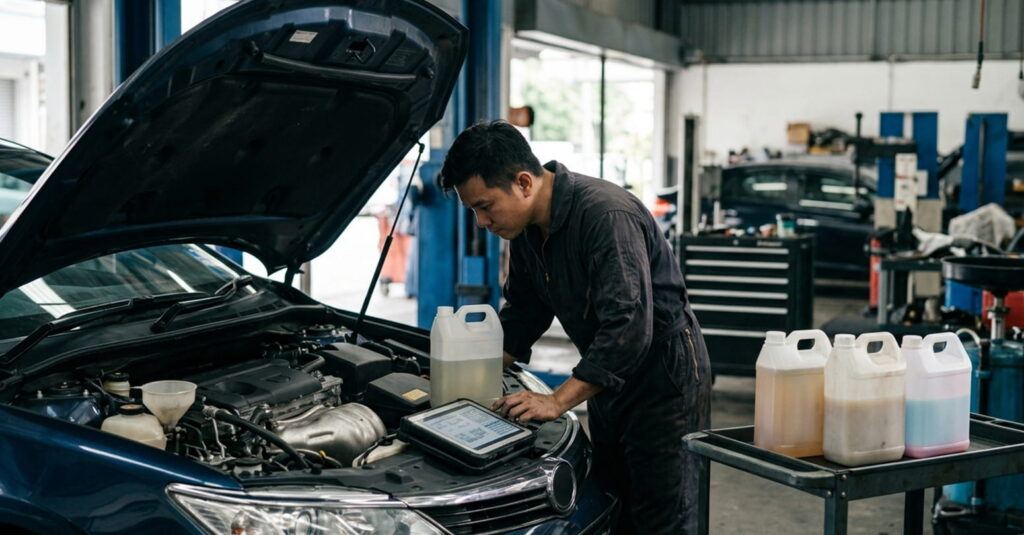
The most reliable way to find the right type is your owner’s manual, not the bottle colour. Manufacturers use different colours for the same formula and the same colour for different formulas. Topping up? Use the same type already in the system. Not sure what’s in there? A full coolant flush and refill is the safer option. Technical service guidance from vehicle regulators confirms that coolants of different technologies are not compatible or interchangeable, and mixing them can lead to corrosion and overheating.
Never pick coolant by colour alone. Two bottles with identical colours can contain completely different chemistry that will work against each other if mixed.
Estremo’s Antifreeze Super Coolant is formulated for passenger cars using pure ethylene glycol with a strong additive package, protecting aluminium alloy and copper-iron radiators and providing solid boiling protection in Malaysia’s climate. If you prefer a hassle-free, pour-and-go solution, Estremo Thermoglide Premix 50/50 Coolant delivers the same robust thermal management and metal corrosion inhibitors in a pre-diluted, ready-to-use formula that requires no additional water. The motorcycle option is Estremo’s Igloo Antifreeze Super Coolant, a 100% concentrate designed for aluminium alloy and copper-iron motorcycle radiators, dilutable down to 20% depending on conditions. Using the right product for your vehicle type is one of the straightforward habits that protects vehicle longevity without extra cost.
How Coolant Condition Affects Engine Temperature and Vehicle Longevity
Getting the right coolant matters. So does keeping it fresh. Coolant that’s been left in too long loses its ability to transfer heat efficiently. As its additives break down, it turns acidic. Acidic coolant attacks aluminium engine components, degrades rubber hoses and seals, and damages the water pump. These failures look like mechanical problems but trace back to coolant that outlived its useful life.
In Malaysian traffic, heat puts a sustained load on the cooling system. Stop-and-go driving in hot weather asks more of radiator coolant than a steady drive in cooler conditions. Checking coolant condition between services, not just at the service interval, is a practical habit here.
What to look for: fresh coolant is clear or lightly tinted. Murky, brown, or rusty coolant has degraded and needs replacing. Staying on top of this is one of the lower-cost habits that genuinely extends vehicle longevity. Estremo’s engine flush guide explains when a full system flush is worth doing before your next coolant change.
Frequently Asked Questions

1. What are the main car coolant types and how do they differ?
The main car coolant types are IAT, OAT, HOAT, and P-HOAT. All share an ethylene glycol base, but they use different rust-prevention additives. IAT suits older cars with cast iron and copper parts. OAT lasts longer in modern engines. HOAT and P-HOAT blend both approaches and are specified by particular manufacturers, with P-HOAT common in Asian vehicles.
2. Can I mix different coolant types together?
No. Mixing OAT and HOAT coolants interferes with both their additives and leaves your cooling system with weaker protection. If you’re unsure what’s already in the system, a full flush and refill with the correct type is the safer option.
3. How often should I change my radiator coolant?
IAT needs changing every two years or around 30,000 kilometres. OAT and P-HOAT can last up to five years or around 240,000 kilometres. Always check your owner’s manual for the exact interval, and check the coolant’s appearance periodically regardless.
4. What happens if I use the wrong coolant type?
Wrong coolant doesn’t cause immediate failure, but damage builds quietly. If the additives aren’t right for your engine’s metal composition, corrosion begins on internal surfaces. Over time, that leads to leaks, overheating, or pump failure that costs more to fix than a routine coolant change.
5. Does coolant condition affect engine temperature?
Yes. Degraded coolant transfers heat less efficiently, causing the engine to run hotter. As it turns acidic, it also corrodes the water pump and internal passages. Keeping the right coolant fresh and at the right level is the simplest way to keep engine temperature stable.
Coolant sits quietly in the background, but what’s in the bottle and how long you leave it there both affect how long your cooling system holds up. Pick the right car coolant type for your engine, check the condition periodically, and follow the change schedule. Estremo’s coolant range covers both passenger cars and motorcycles with formulations suited to Malaysia’s heat and humidity. Browse the full range to find the right fit.