Key Takeaways
- The choice of engine oil has a direct impact on the long-term resilience of your engine under temperature, load and wear conditions.
- Mineral oils generally do best in older or high-mileage engines driven for everyday local journeys and/or motorways.
- Semi‑synthetic oils combine the protective qualities of synthetics with the affordability of mineral oils, offering balanced performance at a lower cost.
- Fully synthetic oils provide the highest thermal stability, and as such, should always be used where the engine is turbocharged, high-revving or with a high mileage.
- A properly chosen additive will complement a good engine oil, providing added protection between service intervals and decreasing deposits inside the engine.
Introduction
Nearly every driver has the same dilemma on every service: explain to the workshop what the manual says and allow the technician to take care of the rest. When the manual was written, your car was brand new; a five-year-old engine, operating in Malaysian traffic (read extreme conditions!), does not run on the exact same standards as the day it left the factory.
According to AAA, synthetic engine oil offers up to 47% more engine protection from wear than conventional mineral oils in extreme temperature situations. There is more to engine oil than what seems to be in the bottle. Mineral, semi-synthetic and fully synthetic oils are fundamentally different due to their different base-stock chemistries and are different in what thermal limits their formulation can tolerate and where their strengths lie.
A wrongly formulated engine oil is not going to fail immediately. The detrimental effect is gradual; it accelerates wear of piston rings, causes higher carbon deposits, and affects fuel efficiency. By the time you observe the tell-tale symptoms, the cost of repair will far exceed the difference in the price of oil.
This guide will walk you through how each engine oil is constructed, what strengths and weaknesses each formulates pose, engine oil treatment, and how to choose the appropriate formulation for your car, driving habits, and pocket.
What is Engine Oil?

Engine oil is pretty much a lubricant which circulates inside your engine to allow all the metal parts to slide over one another freely. It’s other two main jobs are to transport heat away from the engine and suspend all of the dirt and deposits the engine creates, ready to be removed during an oil change.
A base oil which offers the fundamental lubrication property of the oil is then mixed with a “package of additives” that deal with its oxidation resistance, stable viscosity over temperatures, rust and corrosion protection, and cleaning ability. Base oil determines if the oil is classed as mineral, semi-synthetic or full synthetic.
What is Mineral Oil Built For?
Mineral oil is conventional engine oil refined directly from crude petroleum. Although it is distilled and refined before use, many of the natural molecular differences from raw crude oil are still retained.
Because of these molecular differences:
- Mineral oil experiences larger viscosity changes as temperatures rise and fall
- It is less stable under extreme heat compared to synthetic oil
1. Where Does Mineral Oil Work Best?
Mineral oil performs adequately in:
- Older engines
- Engines designed before synthetic lubricants became common
- Vehicles with wider engine tolerances
These engines are generally more compatible with the natural lubricating properties of mineral oil. Another major advantage is cost.
Mineral oil is:
- The cheapest engine oil option available
- Commonly used in fleet vehicles
- Suitable for vehicles that undergo very frequent oil changes
In these cases, the maintenance strategy often relies on:
- Changing the oil more regularly
instead of - Using a more advanced lubricant for extended intervals
2. The Main Weakness: Thermal Stability
The biggest drawback of mineral oil is its lower resistance to heat. This becomes especially important in Malaysia’s driving environment, where:
- Stop-start traffic is common
- Engines remain hot for long periods
- Vehicles spend less time in stable highway cruising conditions
Unlike continuous highway driving, heavy urban traffic causes oil temperatures to stay elevated for much longer.
Mineral oil is more likely to:
- Oxidise at high temperatures
- Break down faster under heat
- Form engine deposits over time
3. How Do Sludge and Deposits Form?
As mineral oil oxidises inside the engine, it can create:
- Sludge
- Varnish deposits
Vehicles caught in peak Kuala Lumpur traffic can experience oil temperatures above 100°C for 2–3 hours during heavy traffic periods. Once temperatures exceed 100°C, mineral oil’s resistance to oxidation deteriorates more rapidly. This becomes especially problematic if oil change intervals exceed 5,000 km.
Over time, sludge formation can:
- Restrict oil flow
- Increase bearing wear
- Accelerate valve train wear
At that point, maintenance intervention may become necessary before the next scheduled service interval.
4. Why Are Shorter Service Intervals Important?
Good engine maintenance with mineral oil requires:
- Shorter oil change intervals
- Oil filter replacement during every oil service
The recommended interval mentioned is approximately 3,000–5,000 kms.
Frequent oil and filter changes help reduce:
- Heat exposure duration
- Contamination buildup
- Oil breakdown from combustion by-products
5. When Mineral Oil Still Makes Sense
Mineral oil is still appropriate for:
- Engines built before 2000
- Carbureted vehicles
- Cars driven short distances at lower speeds
- Company fleet vehicles are strictly maintained at 5,000 km oil change intervals
Outside of these situations, the lower upfront cost of mineral oil can quickly be offset by increased engine wear, higher maintenance costs, and engine cleaning expenses caused by sludge buildup and thermal degradation.
Semi-Synthetic Oil: The Middle Ground

This oil is a blend of mineral oil and synthetic base stock. This addition of synthetic stock makes it more stable for oxidation and also more stable for viscosity over a temperature change when compared with straight mineral oil. It also has the advantage of being cheaper than an oil with a fully synthetic base stock.
For most passenger vehicles in Malaysia, semi-synthetic oil represents a balance between cost and protection. It handles these far better than conventional mineral oil, without carrying the higher cost associated with fully synthetic lubricants:
- City driving heat
- Stop-start traffic conditions
- Daily commuting stress
Semi-synthetic oil, when paired with a suitable quality oil, is commonly suitable for:
- Naturally aspirated 1.5L–2.0L petrol engines
- Many Perodua and Proton models from the 2000s onward
Semi-synthetic oil delivers noticeably better protection than mineral oil under real-world heat and engine load. For many everyday Malaysian drivers, it becomes the “performance-to-value sweet spot” because it balances:
- Protection
- Affordability
- Practical maintenance needs
Estremo P7 Semi-Synthetic Engine Oil covers:
- SAE grades from 0W-20 to 10W-40
- API SN specification
This makes it suitable across a broad range of passenger vehicles:
- Turbocharged engines
- Multi-valve engines
- Naturally aspirated engines
However, semi-synthetic oil is not always the best option for:
- Vehicles that are driven aggressively regularly
- High-mileage engines above 120,000 kms
As engines age, internal clearances increase over time, and higher-grade lubrication can reduce the rate of additional wear. In these situations, full synthetic oil may provide stronger long-term protection and stability.
Fully Synthetic Oil for the Demands You Actually Put on Your Engine
A fully synthetic oil is designed and manufactured synthetically, meaning that it has not been refined directly from a raw crude oil as is mineral oil. It consists of base stocks, normally polyalphaolefins (Group IV) or severely refined mineral oil (Group III) as categorised by the API.
Compared to mineral and semi-synthetic oils, fully synthetic oils have a much more uniform molecular structure. This allows for:
- Tighter viscosity control
- Lower evaporation at high temperatures
- Better resistance to oxidation and breakdown
These advantages become most noticeable in high-stress driving conditions. Fully synthetic oil performs especially well in:
- Turbocharged engines under big boost
- Highway vehicles travelling above 130 kph for long periods
- High-mileage engines generate greater internal heat because of wear and larger internal clearances
One of the key benefits is viscosity stability under heat. A 5W-40 fully synthetic oil can maintain its viscosity protection at temperatures where a mineral oil carrying the same rating may already have dropped below its intended operating range.
For:
- Turbocharged vehicles
- Engines above 120,000 km
- Vehicles regularly exposed to high operating temperatures
Fully synthetic oil is presented not as an optional upgrade, but as the engineered requirement for proper engine protection.
Estremo P9 Fully Synthetic Engine Oil, available in 5W-30 and 5W-40 grades carries:
- API SN approval
- BMW LL-01 approval
- Mercedes-Benz 229.3 and 229.5 approvals
- Volkswagen 502.00 and 505.00 approvals
These OEM approvals are especially important for European vehicles, where manufacturer-approved oils are often required to maintain warranty compliance.
Another major advantage of fully synthetic oil is the ability to support longer oil change intervals. Many manufacturers now recommend intervals of 10,000–15,000 km when fully synthetic formulations are used.
However, under Malaysian driving conditions, including high ambient temperatures, frequent short-distance driving, and dusty urban environments, a more conservative interval of approximately 8,000 km is better for practical long-term engine protection.
How Engine Oil Additives Fit into the Picture?
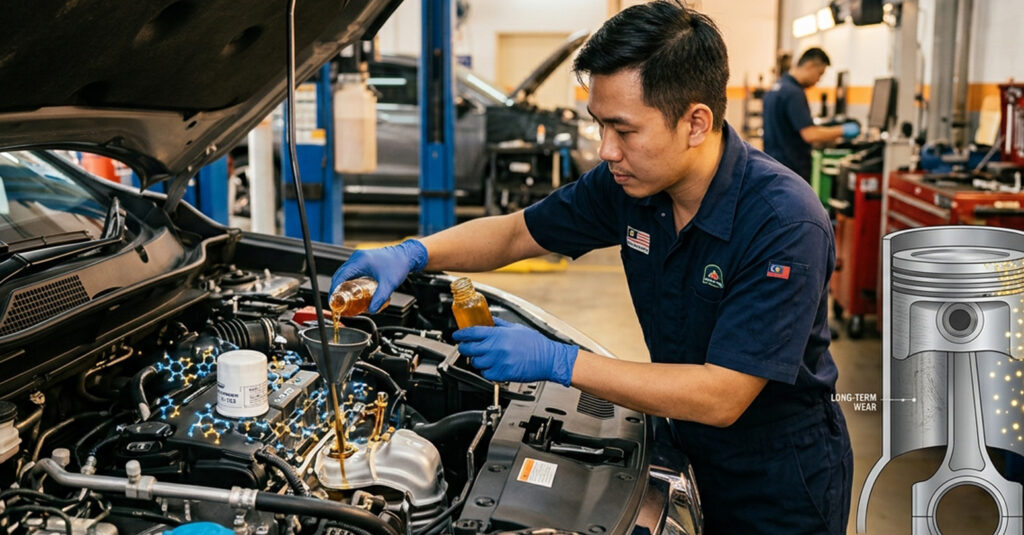
Choosing the correct type of engine oil is only the starting point. Supplementary engine oil additives and engine treatments are designed to handle areas that a standard oil formulation may not fully address. Their role includes neutralising deposits, replacing protective film on worn metal surfaces, and maintaining oil film integrity under pressure. These functions become increasingly important in engines exposed to heat, load, or long-term wear.
One example is Estremo’s Nano Oil Care, an engine treatment developed using nanotechnology. The treatment forms a protective layer over engine components, helping reduce direct metal-to-metal contact, which is one of the main causes of engine wear, especially in engines operating within factory clearances.
The additive is used in:
- 250 ml portions
- For every 4–5 litres of engine oil during servicing
and is suitable for:
- Mineral oil
- Semi-synthetic oil
- Fully synthetic oil
The effects improve progressively over time. When paired with a suitable engine oil, a quality engine oil additive can reduce internal friction in a measurable way. Lower friction results in less energy being wasted as heat, which contributes to:
- Lower oil and engine temperatures
- Reduced oil oxidation
- Better transfer of usable engine output to the wheels
For engines operating under high-load conditions and for queries such as what an engine flush is and when to use one, or vehicles with extended or inconsistent maintenance histories, an engine flush before an oil change is recommended. This helps remove sludge and varnish deposits that build up inside the engine over time.
Which Engine Oil Is Best for You?
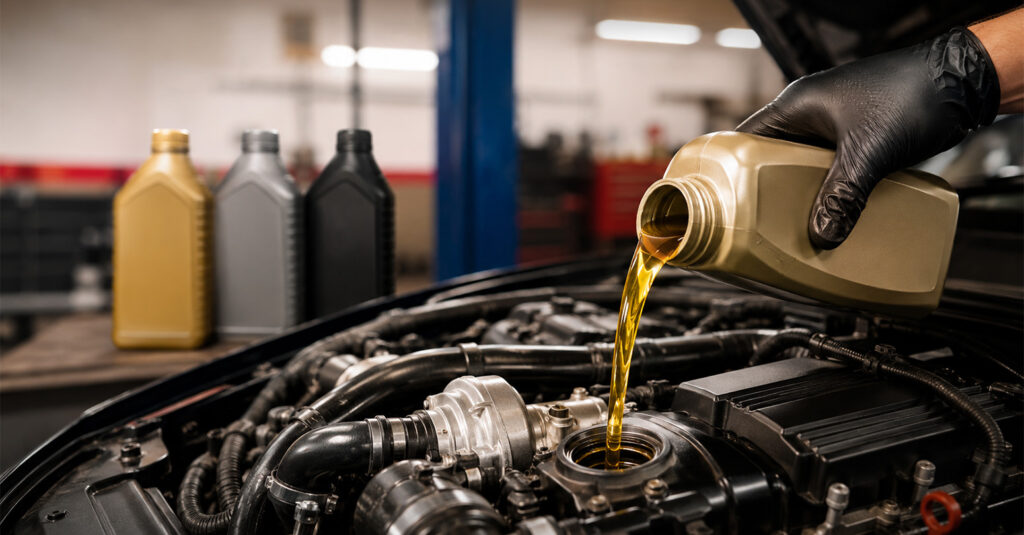
Drivers are not permanently fixed to one oil type. A car using mineral oil at 20,000 km can later move to semi-synthetic or fully synthetic oil at around 80,000 km as part of proper long-term maintenance.
| Oil Type | Best For | Driving Style | Drain Interval | Key Point |
| Mineral Oil | Pre-2000, carbureted engines | Low-stress urban trips | ~5,000 km | Lowest cost, suited for older engines |
| Semi-Synthetic | 2000+ naturally aspirated petrol cars | Urban + highway use | 5,000–8,000 km | Balanced protection and value |
| Fully Synthetic | Turbocharged or 100,000 km+ vehicles | High-speed or high-heat driving | 8,000 km+ | Strongest protection and heat resistance |
The correct oil choice depends on:
- Vehicle age and engine type
- Driving habits
- Oil drain interval
For vehicles frequently driven above 110 km/h for 30 minutes or longer, fully synthetic oil is better suited because it handles sustained heat better and allows safer extended drain intervals.
If unsure, always follow the recommendations in the vehicle owner’s manual:
- SAE viscosity grade
- API service category
FAQs
- Can I switch from mineral to fully synthetic engine oil in an older engine?
Yes, but do it carefully. If your engine has existing sludge buildup, switching directly to fully synthetic oil can loosen deposits that then circulate through oil passages and cause blockages. Running an engine flush before the switch removes accumulated deposits first. Fully synthetic oil cleans more aggressively than mineral oil, so the sequence matters in higher-mileage or neglected engines.
- Is full synthetic engine oil able to sustain longer service intervals?
Yes. Full synthetic oils have slower oxidation rates and retain their viscosity grade longer during use. Typical full synthetics can last 10,000 km-15,000 km on oil drain intervals according to manufacturer recommendations. Based on Malaysian conditions involving high heat and city driving stop-start cycles on short trips, a conservative interval of 8,000km is reasonable and recommended to prolong the engine.
- What does the viscosity grade on engine oil mean?
The number before the W refers to cold-start viscosity. Lower numbers like 0W or 5W flow more easily at low temperatures, reducing wear during engine start-up. The number after the W refers to viscosity at operating temperature. A 5W-40 oil maintains its 40-grade protection at full operating temperature. For Malaysian conditions, where cold-start temperatures are not a concern, the operating temperature grade matters more than the cold-start rating.
- Do I need an engine oil additive when using fully synthetic oil?
Not absolutely, but useful in certain cases. In already having an additive package providing excellent performance within itself, a supplementary additive for engine oil, for example, Nano Oil Care, is most advisable for engines with a mileage greater than 80,000km and for those of the turbocharged type, under high sustained load conditions and/or after an interval of deferred engine service (as part of the vehicle servicing regime). For a new engine in good condition, the oil additive is quite enough.
- How can I tell if my car needs semi or fully synthetic oil?
Observe two parameters: the owner’s handbook for its API service category and viscosity grade, together with a judgement based on your vehicle engine’s current condition and the pattern of your daily usage: if your engine is turbocharged, has a mileage above 100,000 km, or often operates at extreme temperatures, use fully synthetic oil. A high-quality semi-synthetic would suffice under normal daily usage on an NA engine without excessive expense.
Conclusion
The type of engine oil chosen also impacts wear levels within the engine, operating temperature, fuel economy, and cost of engine maintenance over time. The mineral, semi-synthetic, and fully synthetic options offer distinct levels of performance for different driving conditions, mileage levels and stress placed upon the engine.
The margin between engine wear, due to heat levels within the engine, traffic levels within the driving journey and overall mileage, grows the higher the value is. Correct oil selection and an effective engine oil additive alongside proper servicing will result in longer-lasting, smoother, and cleaner engines.
For over 15 years, Estremo has been at the forefront of developing lubricant technologies that are specifically formulated to withstand the high demands of roads and climate conditions in the ASEAN automotive market.
Established in 2010, Estremo has continually developed an array of mineral, semi-synthetic, and fully synthetic lubricants and engine oil additives to cater to passenger vehicles, motorcycles, and high-mileage vehicles. Heatpro technology developed by the brand aims to maintain optimal lubrication in hot conditions and high engine load.
Estremo’s range consists of SAE grades from 0W-20 up to 10W-40, as well as API SN certified formulations and OEM specifications for major brands like BMW, Mercedes-Benz, and Volkswagen. This allows consumers to benefit from lubricants designed for naturally aspirated, turbocharged, and modern multi-valve engines under all conditions encountered in real-world driving.
Besides providing a range of lubricants, Estremo has also been involved in developing engine oil additives which contribute to reduced friction, cleaner engine internals, and oil film strength between changes. All of these products are rigorously tested under Malaysian driving conditions, including stop-start city traffic, long highway drives, and high operating temperatures, making Estremo a reliable lubricant provider focused on durability and long-lasting performance. Contact Estremo today.